
Conversations with my Sister: Budapest
An interview with Anna and Mark von Rosenstiel
With Lïlla Lörinc, at Art Quarter Budapest
Interviewer: So, I'm very glad that you are here. We're going to talk about how you feel, how the exhibition is going, all good things. And please tell me a little bit about your exhibition here at AQB.
Anna: This is only the second time we've ever gone down the path of working together. It did hit me though, that we grew up together, always in our dad's shop. He had tools and wood scraps and hot glue guns and paint.
Mark: So much hot glue. And we could do anything.
Interviewer: What does he do?
Anna: He's a builder and an architect. But he also made all the furniture in our house. Growing up, he was always making things, and he always encouraged us to use his tools in his shop.
Mark: As long as we didn't mess anything up in his shop, we could do whatever we wanted. So I think we spent a lot of time as kids just making weird shit. And if we cut our finger or burned ourselves, we just kept our mouth shut.
Anna: That was the rule. He'd say, “do whatever you want, but if you hurt yourself, you can't complain.”
Mark: We'd glue our hands to boards and just walk around with it stuck to our skin, and take it off like a clamshell. We were always in parallel creative spaces as kids.
Anna: And then I think I went a more traditional art route toward teaching, and Mark went down this path of art and travel and creativity.
Mark: And then, last year, Anna was offered a Portland show, and she got kind of nervous and wanted someone to back her up. We had the idea of working together. That was in February, and it was the first time we'd ever collaborated on a show. So, this is the second show we've ever had together.
Interviewer: Because Mark, you mentioned that you were going to bring your sister to AQB, go down to the mines, and destroy her ceramics.
Anna: Yeah, we had a grand vision.
Mark: Our vision is still grand. But it was cool how it shifted and changed. It was literally a conversation, the way we'd just bounce ideas off each other to create this world. For both of us, it wasn't what we expected.
Interviewer: What I expected was different too, because it seemed so harsh. I thought, “what's the situation between you guys? You're going to just grab her stuff and work with it in this way?”
Mark: I think the destruction part seemed more playful than abusive.
Anna: And it's also reforming. The idea that breaking things isn't always destructive, that breaking things can be really beautiful. When you pick up broken pieces and look at them in a different way, that's when new ideas happen. Even for us, our relationship has gotten further apart and closer, further apart and closer. And in each of those renditions, we grow. Sometimes it's hard or awkward, but without that little bit of animosity, I don't think there's growth or new ideation. And I'm able to feel playful in that space.
Mark: I moved to Portland three years ago with my wife. Annie and I hadn't lived in the same city since high school. We've known each other so well, for all of our lives, but to actually live in the same city, it was like learning ourselves again. It was like you were a stranger in some sense. This project was an exploration of that new space we found in Portland. I'm a very turbulent person, so it was a whirlwind coming to Portland, and figuring out how to use that energy for positive community interactions. Being around Annie, and the community she and her family have, helped make me a better person in that space. I feel like this project was a reflection of that.
Anna: And the reversal. I came here and was taken out of my space, into this space that Mark has curated, and was able to become a better person in a different way. We're both able to gift to one another, almost like the reverse. There were three or four moments working on this show where, without even speaking, we both knew: this is how it needs to shift, this is how it feels. That's just magic, to be able to feel that momentum. I would never have made the things I made here if I weren't with Mark. Being around Mark, having the energy between us, it's that creative funnel. And also the time and space that AQB provides, where my mind could just be weightless. Not empty, weightless. Just expanding out.
Mark: Being in that creative space and waiting for ideas to come to you, versus forcing them. At home your time is so regimented. Here, it was the ease of just sitting and allowing ideas to surface.
Anna: Like sorting rocks.
Mark: Oh my God, watching you pick through trash and sort things, you were like a weird raccoon.
Anna: I was a cute raccoon. An adorable raccoon.
Mark: Raccoons are weird and cute.
Anna: I am a cute raccoon, that's all I'm saying. But yeah, those little moments where we took those creative shifts. It felt like we just looked at each other and they happened. It was cool to know we had that connection as people. I've never actually worked with somebody on a project in this way, so it was very satisfying and a new experience of creating something. And honestly, even if everything we made was completely shit, having that feeling made the whole thing worth it, regardless of the outcome. Understanding that we have the ability to bring out this mutual understanding is in itself an art. So that information, moving forward, makes me really excited.
Interviewer: It's much better if you can say the outcome is secondary — the aesthetics, anything. It's just the flow, living it freely. That's the really important thing, because otherwise it gets a little bit…
Anna: Stressful. It becomes a checklist. It was maybe five days in that we had that first transition of, "oh, this is what we're going to start to do." And it felt way more free-form and poetic versus just describing a project. That was a nice transition.
Interviewer: Let's take this moment to describe the project. So, Anna, you worked with clay — dried clay — and you, Mark, worked with this brutal machinery: wood and tools.
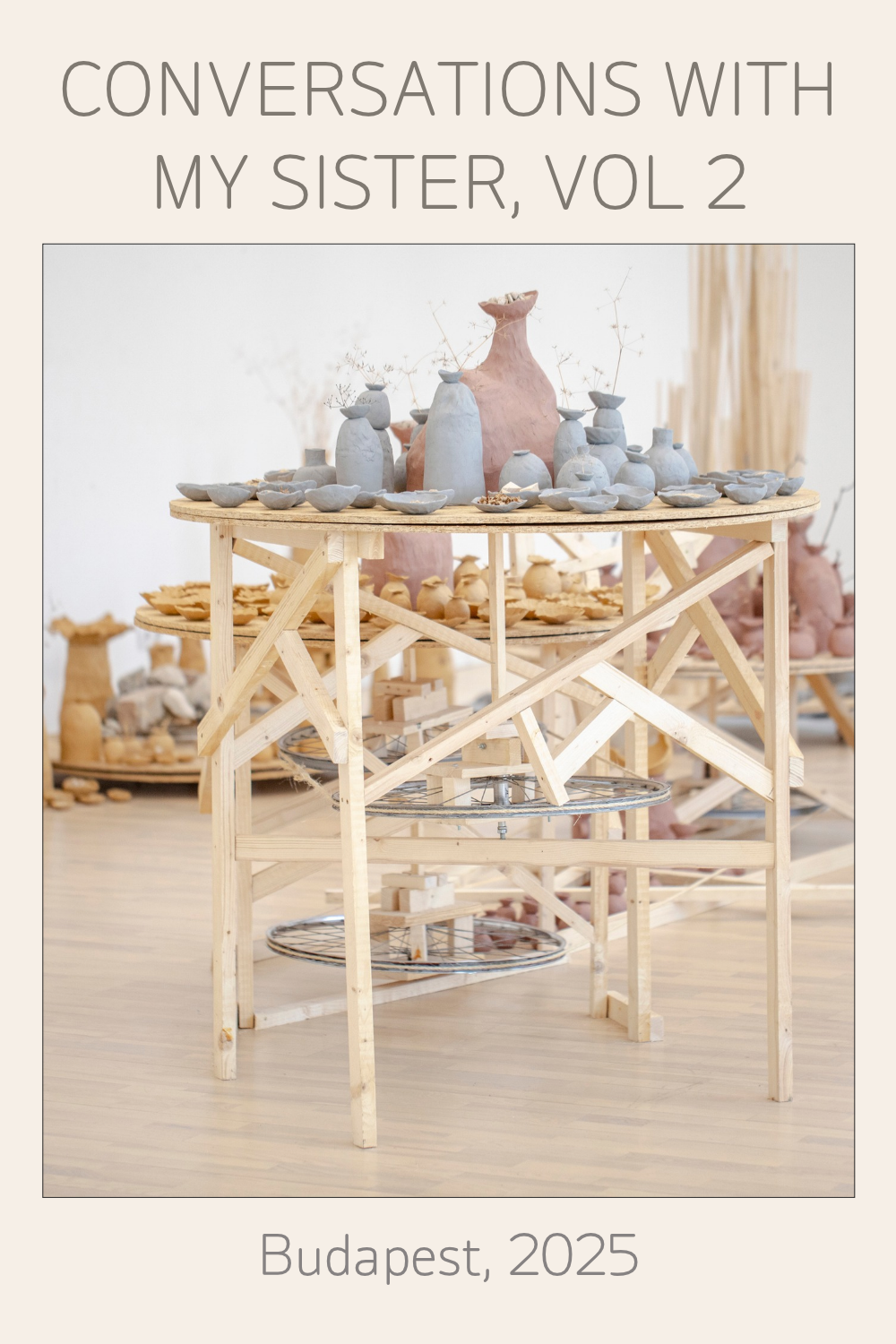
Mark: Yes, little contraptions of lazy Susans. The idea was to have these machines spin and destroy the clay elements in a performance at the beginning of the show. But that changed too, because some of the machines became sort of useless. They were these upside-down machines.
Anna: Discarded.
Mark: We were thinking about the mechanisms, how there are foundational elements of conversations that allow them to be whole and complete and feel good. The idea that those foundational structures of a conversation come from somewhere. It's almost like these little machines evolved into something that can set aside the need for a productive space, to make something new happen.
Interviewer: So that's a change that happened during the process.
Anna: Yeah. And the idea that we start out with patterns that are almost generational, in the way we communicate, the way we see ourselves. I liked that during the creative process we realized that having everything be functional didn't actually make sense. Nothing is completely functional. So the importance of having dysfunction and function, beauty and wrecked raw things, that's just more real. It was, "oh, obviously this shouldn't just be one thing, because nothing is just one thing."
Interviewer: But that's what you can't think through before you start the process. You've got to be in the process.
Mark: Yes. Annie was coming from this place of making products. So the concept had become more of a product — this idea we'd give you like an ice cream cone. But then that fell away and it became more free-flowing. And I feel like we both became more satisfied in the experience.
Anna: And just using things you found, like the old bike wheels, the cool rope, the plywood. All these different materials, and the colors of them. They were all a little monochromatic and broken. And strangely the clay tones went so well with the wood. It was bizarre.
Mark: It was beautiful. I think when something works, it becomes a magnet and draws beautiful things to it.
Anna: Yeah, that's what happened.
Mark: What was also funny was that during the opening, the machine was supposed to work way longer than it did. My ego was very bruised when it broke immediately. But it was nice to step back and look at this world we'd built, addressing the set of ideas we'd intentionally gone into the process thinking about. Even the small gesture-movements that created some change in the dynamics of the piece. It was very satisfying to look at the whole work at the end.
Anna: I told Mark, “that's awesome, your machine broke. That's the entire point of this whole piece. The splintering of that wood, that sound.”
Mark: The sound was amazing.
Anna: And it looked so cool. There's the ceramics at the end, pulled and cracked, and now the wood is matching the dying clay. To me, the broken machine, the sagging ropes, it became insane. It became a new object. It perfectly encapsulated the idea that we had before.
Mark: And even the bruising of my ego, and being able to step back and say, "oh, why did I feel like that?" Not reframing it, but really thinking: the story of what we created is actually that feeling, too.
Anna: For sure. And it's so connected to who we are individually, but also together. Supporting each other through the process, even in that moment, is part of the story. It felt like the whole project tumbled into itself. It kept giving birth back to itself, in its iterations of change. Really satisfying.
Mark: It's like when the materials all gravitate to each other and you start to make this black hole of an idea, where it sucks everything into it, and the light comes out in a little penumbra. It was cool how it became self-contained.
Anna: And us trusting each other. Whatever happened, it's just good. And in that moment, it's, "oh yeah, we can move forward, this can happen." We're friends again.
Interviewer: Well, I really do envy you guys, because it must be amazing to live this through as siblings. I have this collaboration with János, so we have this kind of conversation, but having it with your family is something extra.
Mark: I would have loved if someone could have watched us in those moments where we understood each other implicitly. When I was watching you and János spray-paint on the roof, it was like watching birds, these feathers that just know how to migrate to the right place. I was curious how we looked in those moments too, where that unspoken language transformed into actual agency, creating something.
Anna: There's this parallel work that sometimes just hits and then goes back out, hits and goes back out. For me it was an incredible experience, never really having made something like this, and also just working with somebody else. I tend to be a very solitary creature. But it was a thing where we did spend a lot of time apart, making our separate things, and then we had these couple of days where it just felt like a natural rhythm. And necessary, because wasn’t going to chop wood on that weird saw you made out of a few buckets of water and and an upside down skill saw and rope.
Interviewer: Okay, but I've got to go back to the very beginning. How did you guys end up here?
Mark: The very beginning is that in 2015, I was doing my residency at MeetFactory in Prague, and I met Koós Gábor right at the end of it. We had this very intense, emotional night out, talking about all these things in our lives. I was supposed to just have a three-month residency and go back to the States, and then he convinced me to stay in Europe, which ended up being a six-year life. Coming to Budapest, he found AQB. You and János were here. There were about five artists.
Interviewer: Well, it was a long time ago. It was ten years.
Mark: Ten years. I was living here for a year and a half, bouncing around different residences, but always coming back to AQB, because the community here is amazing. Wolfie's amazing. Everyone here, they're very good people. It's hard to stay away.
Anna: And then, in 2023, Mark was going to have a show at MeetFactory. For me, I love Mark so much, and I feel like I know so much about him, and I also know nothing about him. So I thought, if I really want to know Mark, I have to go see this side of him, because it's a huge part of him. I wanted to go because it also explains why we can work well together. I have this deep desire to really know him. There's always this assumption, “well, you're related, of course you know each other.” But no. I can hear the stories, see the pictures, call while he's gone, but I can't really know. I have to feel it. I have to smell the weird air, see that one step where the paint's worn off. I need to see the details. So I was like, "fuck it, we're all going to Prague. We're all going to see Mark's opening." I dragged the whole family there. Everyone showed up.
Mark: The MeetFactory open studios are epic. So much art, so many creative people in one place, it sets your mind on fire. And watching Anna in that space, I was like, "oh, we have to do a residency together. You have to come work in Europe."
Anna: That was the first place where I was standing in Mark's studio and it just hit me: I'm going to build this tower of clay, and Mark is going to have hammers falling down and breaking the whole thing. I saw the whole thing in my brain. And it was a destructive thing right off the bat. We've always talked about family dynamics, breaking down assumptions and communication barriers, and having the ability to change our familiar patterns of how we interact and communicate. So, not destruction in a bad way.
Mark: Not at all. It was the joy I could see on Annie's face. "We'll figure out a way to get you to Europe." AQB at that point felt much more ingrained in the community here, and it seemed like a better fit. So I reached out to Wolfie and said, "hey, we'd love to work on a project," and he was very open to it. At that point we really formulated what we were going to do. We talked about the destruction of clay, something super repetitive, an ongoing thing we couldn't escape, like the dynamics of a family. But then it changed so much once we got here.
Anna: And doing the show in Portland, before we got here, was a nice little tester to make sure we could work together.
Mark: Alright, we want to make things, still. And I've been coming here so long, maybe I take my time here for granted. Watching how productive and engaged Anna was with her time was a reminder of, "oh, this is what I'm doing. It's a very special place and time that I'm able to have.” Watching Anna explode into the space, and watching this space reflected in her experience, it made me remember: this place is insanely important to who I am. And what it gives the people who come here. I'm very grateful to have seen in fullness again, where I hadn't found that for a couple of years.
Interviewer: Tell me about it. For me as well, the same. I also somehow take it for granted.
Mark: It's almost like a rocket ship, where your velocity becomes the default. You don't realize you're traveling between stars, and then suddenly it's like, "oh — we're traveling between stars, this is crazy." The experience of being here, the people, the way ideas freely flow between people in the community, the people you get to meet — it's a phenomenal place. But then I got back that sort of freshman-year orientation to a space so much larger than you could ever describe. Very satisfying.
Interviewer: So, are there plans for the future?
Mark: Wolfie says maybe we should just come to AQB back sometime.
Anna: Definitely. I'm going to miss you guys, just seeing you walk by, day to day.
Mark: I've had one friend visit here in the last while, so I'm just so grateful to share it with someone. That means so much to me.
Anna: The biggest takeaway for me is that AQB gave me the space to completely slow down and speed up at the same time. To be completely lost, and also neurotic. It's a strange combination of not having anything to do except completely following where my hands lead me. I could could stretch my time however I wanted. And to have the actual physical space! We went and got 400 kilos of clay. That's so much clay. I didn't even think, "is this enough? I think we might need to get more." Just the fact that I could get 400 kilos of clay and a big tarp and start smashing it around. How amazing to have that unbridled freedom.
Mark: Just squirreling around the floor, flopping around, pushing wood, cutting wood outside. To have that space to fabricate in was pretty incredible.
Anna: And the other part about us working together: as we were waiting, we needed a few more wooden parts, and while I waited for Mark to finish those pieces, that's when I started to collect all the objects lying around, on the floor and outside.
Mark: Almost like you needed something to do, you gave yourself a task.
Anna: Actually I feel like it's the opposite. At home I'd have been, "I'm done with my part, now I'm moving on to work, emailing, laundry." Instead, I was looking around. I'd made all these empty vessels. And everything around us, when you really put it together, is quite beautiful. It made me look at the things I'd made with patience, and then look around and think, "what can I do with the things that would just be thrown away?" Seeing them in a very different way. I really appreciated the time and space to not have anything to do except look around. That's AQB, that's being here, the gift of time.
Mark: You're kind of voracious in that space.
Interviewer: Thank you, Anna. Thank you, Mark. Lovely. Are we able to do another event?
Mark: Yeah, next summer we'll do another thing.
Anna: We're going to come back.